
Google has hit us with a lot of major algorithm updates this year and there’s still time for another surprise or two before 2021 comes to a close. Even if Google gifts us with a quiet holiday season, this has been one of the most volatile years for some time.
Last week, we summarised some Semrush data showing an 84% increase in volatility in the mobile SERPs this year, compared to 2020. The findings show that this year’s heavy hit of algorithm updates has had a significant impact on ranking volatility. So, we thought it might be a good idea to remind ourselves of the biggest Google algorithm updates that made an impact in 2021.
Which Google algorithm updates are we looking at in this article?
In this article, we’ve selected nine of the Google algorithm updates in 2021 that had the biggest impact on the SERPs, required the most optimisation to deal with or significantly impacted the search experience for users.
Here’s a quick summary of the updates we’re looking at in more detail:
- About this result (1 Feb): Google adds an “About this result” tab for users to view contextual information about results and why they ranked for their search.
- Passage Indexing (10 Feb): Google starts using AI technology to select passages from page content to show in featured snippets and improve the relevance of results.
- Product reviews update (8 Apr): Google targets thin product reviews or summary review lists while rewarding in-depth review content.
- June 2021 Core Update (2 Jun): The first of a two-part core algorithm update.
- Page experience (15 Jun): Google introduces a new ranking signal for measuring user experience.
- Spam update (23 Jun): The first half of a two-part spam update.
- Spam update (28 Jun): The second half of Google’s two-part spam update.
- July 2021 Core Update (1 July): The follow-up to June’s core update.
- Page titles update (24 Aug): Google updates the way it shows and generates page titles in the SERPs.
In this article, we’re going to explore each of these Google algorithm updates in more detail and explain why they made such a big impact in 2021.
#1: About this result update – 1 February 2021
The first big algorithm update in 2021 didn’t impact search rankings but changed the way users can interact with results in the SERPs. Google rolled out the “About this result” tab, which users can access to view information about every result on the page, including details about the publisher and why the result ranks for their query.
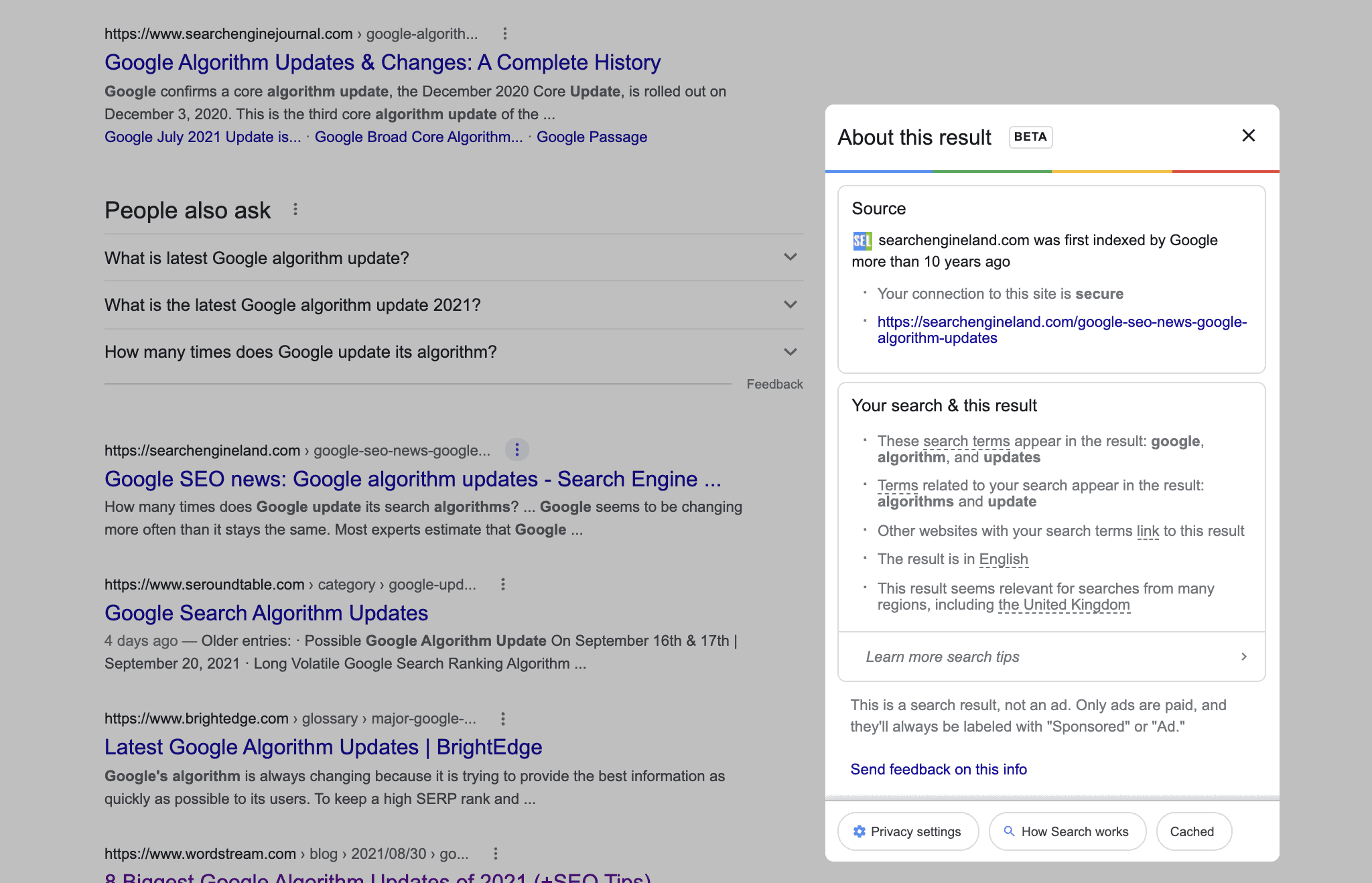
To access the “About this result” tab, users simply need to click on the three-dot icon that shows at the top left of each result on the page. This brings up the tab to the right of the screen on desktop or the bottom of the display on mobile devices.
The “about this result” tab shows information about the publisher/website, including the first time the domain was indexed by Google, confirmation of a secure connection (or lack of one) and the page URL the result links to.
The tab also includes info explaining why the result shows for the user’s query, such as its relevance to their keywords, the presence of relevant links, the page language and more.
#2: Passage Indexing update – 10 February 2021
In October 2020, Google announced passage indexing as part of a summary of future updates and features, powered by artificial intelligence.
Google explained passage indexing as follows: “With new passage understanding capabilities, Google can understand that the result on the right is a lot more relevant to a specific query than a broader page on that topic. In this case, our systems were able to highlight a featured snippet, but this improvement applies to how we rank web pages overall.”
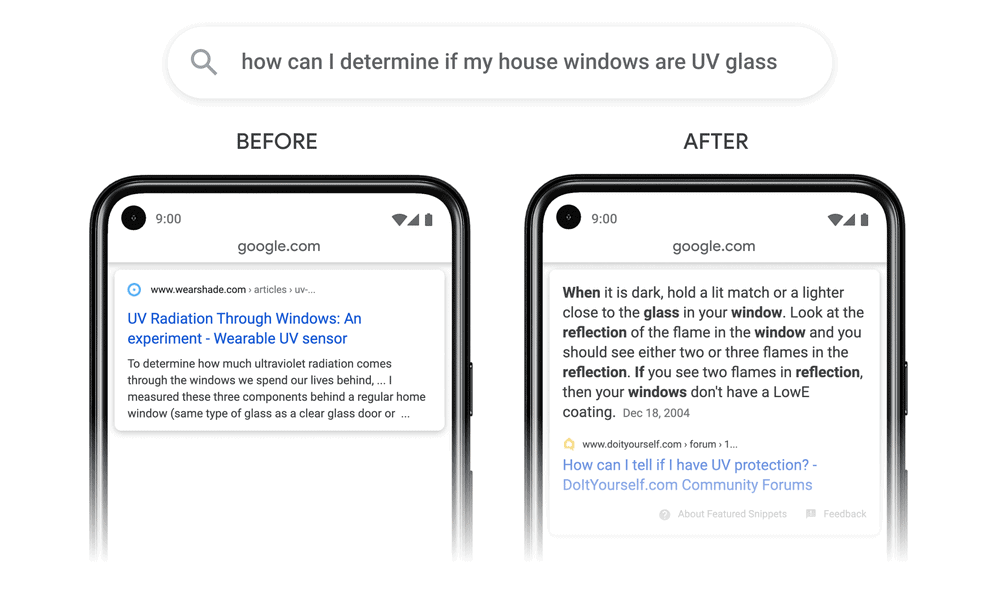
On 10 February 2021, Google rolled out passage indexing for English search results in the US and the search giant said it affected 7% of all queries, making this a significant update.
As with many recent updates, Google says there’s nothing SEOs can do to optimise for passage indexing as the technology is centred around how Google understands content and displays passages. However, any improvement in Google’s ability to understand queries with greater accuracy opens new search opportunities that didn’t exist or weren’t reliable enough to target with content.
Likewise, any Google algorithm update that affects 7% of results means some people are losing traffic and measures need to be put in place to recover visitor numbers.
#3: Product reviews update – 8 April 2021
After a quiet March, Google had another big update for us in April and the search giant itself called this one the “product reviews update”. As the name suggests, the update targeted product review content, which is significant for any publisher or affiliate marketer that regularly posts product reviews on their website.
Here’s what Google had to say in its announcement of the update.
“Google Search is always working to show the most useful and helpful information possible, through testing, experimenting, and review processes. From this, we know people appreciate product reviews that share in-depth research, rather than thin content that simply summarizes a bunch of products. That’s why we’re sharing an improvement to our ranking systems, which we call the product reviews update, that’s designed to better reward such content.”
Essentially, Google was targeting thin reviews that only offer a basic summary of products and review lists that often only include some basic features and a short description for each product. To help publishers deal with the update, Google also offered up a list of questions for content creators to ask about their review content before publishing.
To satisfy the new demands of the update, Google encourages publishers to check whether their content does the following:
- Express expert knowledge about products where appropriate?
- Show what the product is like physically, or how it is used, with unique content beyond what’s provided by the manufacturer?
- Provide quantitative measurements about how a product measures up in various categories of performance?
- Explain what sets a product apart from its competitors?
- Cover comparable products to consider, or explain which products might be best for certain uses or circumstances?
- Discuss the benefits and drawbacks of a particular product, based on research into it?
- Describe how a product has evolved from previous models or releases to provide improvements, address issues, or otherwise help users in making a purchase decision?
- Identify key decision-making factors for the product’s category and how the product performs in those areas? For example, a car review might determine that fuel economy, safety, and handling are key decision-making factors and rate performance in those areas.
- Describe key choices in how a product has been designed and their effect on the users beyond what the manufacturer says?
In other words, review content must include detailed information from reviewers who have genuinely used the products in question and have real knowledge (authority) of the product type. Reviews should include valuable information readers can’t simply find from product pages and personal experiences from actually using the products, which potential buyers can relate to.
Google wants reviews to help people make buying decisions with in-depth info comparing products to similar alternatives.
#4: June 2021 Core Update – 2 June 2021
On 2 June, Google started a 10-day rollout of the first core algorithm update of the year, the June 2021 Core Update. Core updates normally take up to 14 days to fully roll out but Google took to Twitter to announce its latest update was complete on 12 June.
The June 2021 Core Update rollout is complete as of June 12, 2021.
— Google SearchLiaison (@searchliaison) June 15, 2021
Interestingly, this update seems to take longer than usual to make a significant impact on the SERPs and many data providers were speculating that the rollout could take longer than the usual two-week period.
Instead, the initial impact from the rollout was felt a few days later than expected and rollout was fully complete a few days early at the other end.
The update appeared to target quality content although the impact from the June Core Update was lower than we’re used to seeing from core updates and a run of other updates in the coming weeks would make it even harder than usual to identify the cause of ranking changes.
In another uncharacteristic move, Google also announced a second core algorithm update would follow a month later.
#5: Page experience update – 15 June 2021
In May 2020, Google announced it would introduce a new cumulative ranking signal for measuring the quality of user experience on web pages, called page experience. On 15 June 2021, Google started rolling out the signal in a gradual update that would continue through to the end of August.
The page experience update is now slowly rolling out (Top Stories will begin using this new signal by Thursday). It will be complete by the end of August 2021. More here: https://t.co/kDwhhOYklK
— Google Search Central (@googlesearchc) June 15, 2021
Page experience is a cumulative ranking signal that combines several signals related to UX performance into a single, quantifiable score.
The signals included in page experience are:
- Mobile friendly
- Safe browsing
- HTTPS
- No intrusive interstitials
- Core Web Vitals:
- Loading
- Interactivity
- Visual stability
These seven individual signals are all considered in your page experience rating, which enhances Google’s ability to measure the quality of experience users engage with once they click through to a website.

Core Web Vitals are a key component of the page experience signal and they’re a relatively new addition to the algorithm. They assess the loading time of pages, the response time of interactive page elements and the visual stability of page elements.
- Largest Contentful Paint (LCP): This measures loading times by tracking the time it takes for the largest element above the fold to fully render.
- First Input Delay (FID): This measures Interactivity based on how long it takes for interactive elements to trigger after the user’s initial click.
- Cumulative Layout Shift (CLS): This measures visual stability by detecting any elements that unexpectedly move or change size after the page has loaded.
Google initially played down the importance of this update but John Mueller spoke out in response to many SEOs claiming the update wouldn’t have much of an impact on the SERPs. Unfortunately, it’s difficult to say, one way or the other, because this update was sandwiched by so many others.
#6: Spam update (part 1) – 23 June 2021
After a quick-fore core update and page experience rollout, Google surprised us with another announcement on 23 June. This time it was simply called a “spam update” and Google told us rollout would be complete by the end of the day.
As part of our regular work to improve results, we've released a spam update to our systems. You can learn more about our efforts to fight spam in this post:https://t.co/piCLhbZPkH
And this video below:https://t.co/xMYWm4HPze pic.twitter.com/83IL0EB9Lm
— Google SearchLiaison (@searchliaison) June 23, 2021
Once again, Google announced the update would be followed by a second update – this time, another spam update in the following week.
The purpose of this update is to protect users from spam, phishing and other online dangers by removing hacked pages from search results.
#7: Spam update (part 2) – 28 June 2021
As promised, Google rolled out its second spam update on 28 June and revealed that both of the spam updates were global rollouts. Once again, Google said the update would be finished by the end of the day and the short time frame for these updates do help isolate their impact somewhat from the longer rollout times of other updates.
#8: July 2021 Core Update – 1 July 2021
When Google announced the June 2021 Core Update it forewarned us that a second core update would follow in July but it still managed to catch us out by starting rollout on the very first day of the month.
The July 2021 Core Update, previously announced, is now rolling out:https://t.co/6Xs77WDsur
These typically take 1-2 weeks to finish. Our guidance about such updates is here:https://t.co/e5ZQUA3RC6
Here’s more on how we improve search through updates:https://t.co/IBmInwGOiX
— Google SearchLiaison (@searchliaison) July 1, 2021
Given the busy roadmap of algorithm updates leading up to the July 2021 Core Update, this was a particularly difficult one to monitor. As with all core updates, you never know what Google is tweaking under the hood and interference from the page experience update that was still rolling out only complicated things further.
That said, it seems like low-quality content and links were potential targets in this second core update although some of this could have been influenced by the two spam updates – both of which are difficult to isolate independently.
#9: Page titles update – 24 August 2021
From August 16, website owners started reporting unusual behaviour of page titles in the SERPs. More specifically, it appeared that Google was changing the page title shown on the results page from the title placed in the <title> tags by website owners with greater frequency and more extremity.
Google has adapted page titles for many years now to make results more relevant to user searches (within reason) and encourage more clicks. However, Google was clearly doing this far more often than we were used to seeing and changing titles more drastically than we had seen in the past.
On 24 August, Google confirmed an update to how it generates web page titles on results pages.
“Last week, we introduced a new system of generating titles for web pages. Before this, titles might change based on the query issued. This generally will no longer happen with our new system. This is because we think our new system is producing titles that work better for documents overall, to describe what they are about, regardless of the particular query.” – Danny Sullivan, Search Liaison at Google
Sullivan also highlighted three common scenarios where Google might change page titles in the SERPs:
- Very long.
- “Stuffed” with keywords, because creators mistakenly think adding a bunch of words will increase the chances that a page will rank better.
- Lack title tags entirely or contain repetitive “boilerplate” language. For instance, home pages might simply be called “Home”. In other cases, all pages in a site might be called “Untitled” or simply have the name of the site.
The update wasn’t received with too much positivity from SEOs and website owners, many of whom want to retain control over what shows in the title. Others raised concern over the risks of Google producing inaccurate or misleading titles and what this could mean for the publisher that had no control over the adaptation of their original title.
Have you suffered from Google algorithm updates this year?
However you look at it, 2021 has been a busy year for Google algorithm updates and a particularly challenging one, given the cluster of updates rolled out during the middle of the year. Google certainly hasn’t made it easy to identify what’s being targeted in updates and fix any issues that may have caused issues for certain sites and pages.
If you’re struggling to keep up with the run of Google algorithm updates, you can speak to our SEO team for help by calling 0161 870 2580 or sending us an email at info@hotclickmarketing.co.uk.