
Earlier this year, Google announced a new ranking signal designed to rate the user experience of web pages. The search giant has increasingly favoured positive UX over the years with major ranking factors, such as mobile-friendliness and page speed, as well as a number of indirect signals that can be used to gauge the experience of individual pages.
It’s no exaggeration to say that user experience is one of the most important aspects of ranking in search, even if it isn’t a direct ranking factor itself.
With Google’s new page experience signal, UX is set to become even more important and, according to the search giant’s own words, it could be the deciding factor between pages that deliver similar content quality.
What is this new page experience signal?
Google’s new page experience signal is actually a combination of new and existing signals related to different aspects of UX performance. The illustration below offers an overview of the signals being used to calculate page experience and many of these should look very familiar.
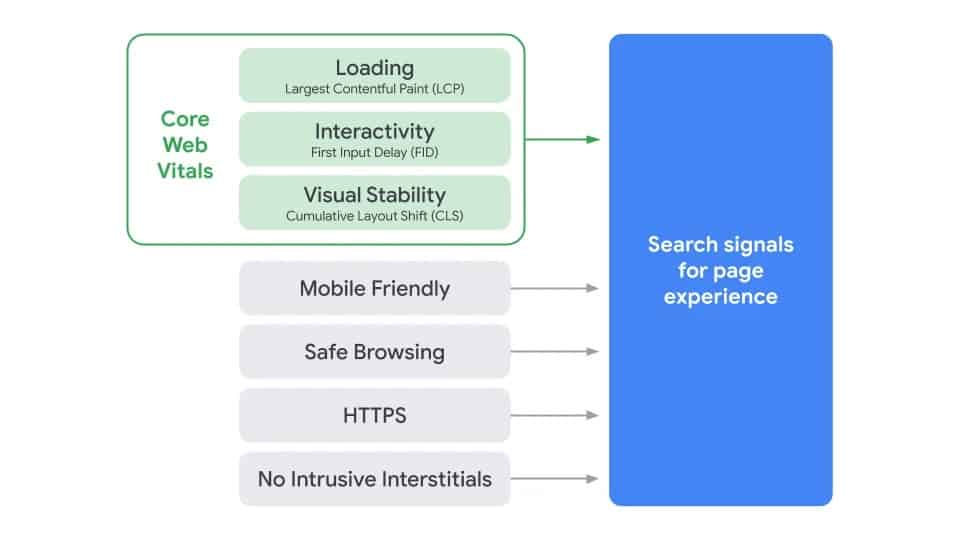
By combining these factors into a new page experience signal, Google will be able to measure them all independently and combine them into a single calculation for measuring the quality of UX delivered by individual pages.
In other words, Google can assess the mobile-friendliness of your pages independently and use the same score as part of your page experience calculation.
By now, you should be familiar with the four grey signals shown in the illustration above. Here’s a quick recap for the sake of clarity:
- Mobile-friendliness: Google’s fairly basic assessment of whether your site delivers a positive experience on mobile – you can test this for yourself here.
- Safe browsing: This checks for any malicious code on your site, such as malware, or deceptive content – and there’s a free test for this too.
- HTTPS: Google also checks whether your website uses HTTPS secure encryption and gives a small ranking boost/penalty in return.
- Interstitials: Google penalises intrusive interstitials and popups, particularly on mobile.
The other three signals listed above are part of a relatively new initiative from Google, called Core Web Vitals. Now, these might be a little less familiar to you so let’s take a look at each of them in more detail.
What are Core Web Vitals?
Core Web Vitals is a new initiative from Google that aims to improve the performance and health of websites. It offers developers a new set of KPIs along with tools to measure and optimise them.
Google says that the specification for Web Vitals will continue to change over time but there are currently three new metrics listed under the Core Web Vitals being used as part of the page experience signal.
These are:
- Largest Contentful Paint (LCP): This measures loading times by tracking the time it takes for the largest element above the fold to fully renders.
- First Input Delay (FID): This measures Interactivity based on how long it takes for interactive elements to trigger after the user’s initial click.
- Cumulative Layout Shift (CLS): This measures visual stability by detecting any elements that unexpectedly move or change size after the page has loaded.
Google has given very dry, technical names to each of these new metrics but they’re basically measuring loading times, interactivity speed and the stability of page layouts.
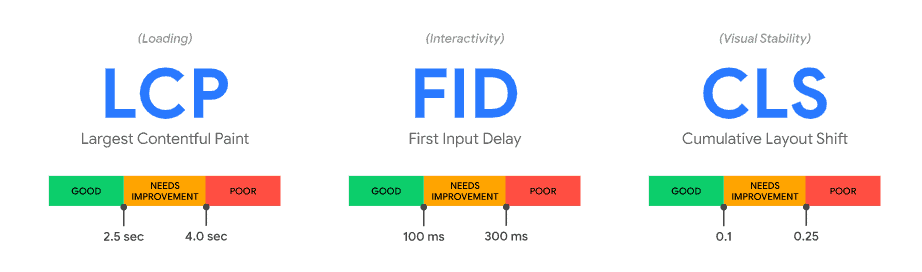
The search giant now has a new method of measuring page speed and it can now measure the time it takes for interactive page elements to respond – as well as layout shifts or breakages that can severely impact the user experience.
You can find out more about these new metrics here, along with information about the tools Google is providing to measure them and optimise.
How important is the new page experience signal?
Now that you have an idea of what the page experience signal entails, the key question on your mind is probably how important this is going to be for page rankings. The short answer is: very important.
For many years now, Google has placed increasing importance upon signals that point towards positive UX and we can see this is the four established signals being used to calculate page experience: mobile-friendliness, safe browsing, HTTPs and interstitials. In addition to these, one of the three Core Web Vitals included in page experience is a new method of measuring loading times, which have been a ranking factor for many years now, too.
To sum up, Google takes user experience very seriously – enough to come up with an entirely new signal that will allow it to easily calculate a single score for UX.
In terms of how important the page experience signal will be, you only have to look at the original announcement to get an idea of the weighting this signal is expected to have:
“While all of the components of page experience are important, we will prioritize pages with the best information overall, even if some aspects of page experience are subpar. A good page experience doesn’t override having great, relevant content. However, in cases where there are multiple pages that have similar content, page experience becomes much more important for visibility in Search.”
Based on Google’s assessment, page experience is going to be one of the key secondary ranking factors besides content quality – so it couldn’t really be much more important. In fact, Google specifies that page experience could be the key deciding factor in which page ranks highest when content quality is determined to be the same or indiscernibly similar.
In the modern days of search where it’s so difficult to get the edge on competitors through pure content quality, page experience could make all the difference.
What do I need to do?
The good news about page experience is that most of the signals being used to calculate it are already known factors. You should already have strategies in place for optimising these and it’s only those Core Web Vitals that might take a bit of getting used to. There’s more good news, though, because Google provides all the tools you need to measure these new metrics and optimise for them to improve performance – everything you need to know is right here.
The other great thing about the page experience signal is that it opens up a new opportunity for brands to compete in the SERPs. This is important because it’s only getting more difficult to make ground on your competitors and jump ahead of them in organic search. The page experience signal provides a wide playing field for competition and it rewards brands for delivering positive experiences – something that should also benefit conversion rates, paid advertising campaign performance and other KPIs that boost business performance.