
In the search marketing industry, there are a lot of myths and misunderstandings about the core fundamentals. A lot of this comes from online speculation among webmasters but there’s a lot of unfounded speculation among marketing experts themselves.
This prompts Google figures such as Danny Sullivan and John Mueller to periodically set the record straight on a number of issues raised on social media and questions asked in Hangouts sessions.
The latest of which saw Danny reaffirm that structured data has no impact on where you rank in search after comments from one webmaster blew up on social media.
What prompted Sullivan to come out and address this?
Last week, a food blogger took to Twitter to explain that she had received an email from Google explaining that structured data for calorie counts should be added to recipes. The blogger in question misinterpreted the message as meaning that her results would no longer rank in search if she failed to add the calory counts to her listings.
Me: *Trying to create a food blog that doesn’t participate in diet culture.*
Google: Enable calorie counts on your recipe cards or risk not appearing in search results! pic.twitter.com/XQVKo4ofXC
— Rebecca Eisenberg (@ryeisenberg) January 15, 2020
The tweet, which was posted on January 15 was seen by thousands of people and sparked a bit of a backlash against what was interpreted as a heavy-handed approach by Google. Danny Sullivan admitted that the wording of the email could have been clearer but moved to assure everyone that the notice was merely a suggestion, not a requirement.
He also reaffirmed that structured data has no impact on where content ranks in the SERPs.
What exactly did Danny Sullivan say?
Apologies for any concern this message may have caused. To be clear, it does *not* mean that your recipes or content will not show in search. As it says, it's a *suggestion* of something you might wish to try or can ignore. It has no impact on your ranking in Google Search….
— Danny Sullivan (@dannysullivan) January 15, 2020
Sullivan started by apologising for any confusion the email may have caused and reiterated the facts that it was simply a suggestion that has no impact on search rankings. He went on to explain the scenario in more detail.
“Yesterday, a concern was raised that calorie information was required for recipes to be included in or to rank well for Google Search. This is not the case. Moreover, structured data like this has no impact on ranking in web search. This thread has more we hope eases concerns…
Content owners can provide structured data as an optional way to enhance their web page listings. It has no impact on ranking. Using it may simply help pages that already rank well appear more attractive to potential visitors.”
You can see more details and responses from others by clicking on the thread and reading the conversation.
Essentially, the key point is that structured data is used to enhance the visual appearance of search results and the experience of engaging with them. It doesn’t have any direct impact on where you rank in the SERPs but it may affect the way users interact with your listings. This may have an indirect impact on your ranking in terms of increasing CTRs and telling Google that your results should be prominent on relevant results pages.
However, there is no direct ranking boost or penalty related to structured data.
In other words, you’re not going to be punished in any way for not using structured data or not implementing any Google recommendations, such as the one this food blogger received.
How important is using structured data?
As Danny Sullivan explains, structured data has no direct impact on your search ranking but there are major benefits to using this markup – some of which do have an impact on where/how you rank in the SERPs.
Above all, structured data provides Google with contextual information about your content and the first benefit of this is making it easier for its algorithm to match your content with the most relevant queries.
“Google Search works hard to understand the content of a page. You can help us by providing explicit clues about the meaning of a page to Google by including structured data on the page. Structured data is a standardized format for providing information about a page and classifying the page content; for example, on a recipe page, what are the ingredients, the cooking time and temperature, the calories, and so on.”
This benefits you by increasing the relevance of people who see your content, which should result in higher CTRs and conversion rates once users actually click through to your pages. This is enhanced further by the way Google presents results in the SERPs that provide relevant structured data.
For example, if you provide details about your products using structured data, Google can display this information in search. So, if you’ve got a solid review score, you can add this using structured data and also add pricing info to entice people with an idea of how much they want to spend.
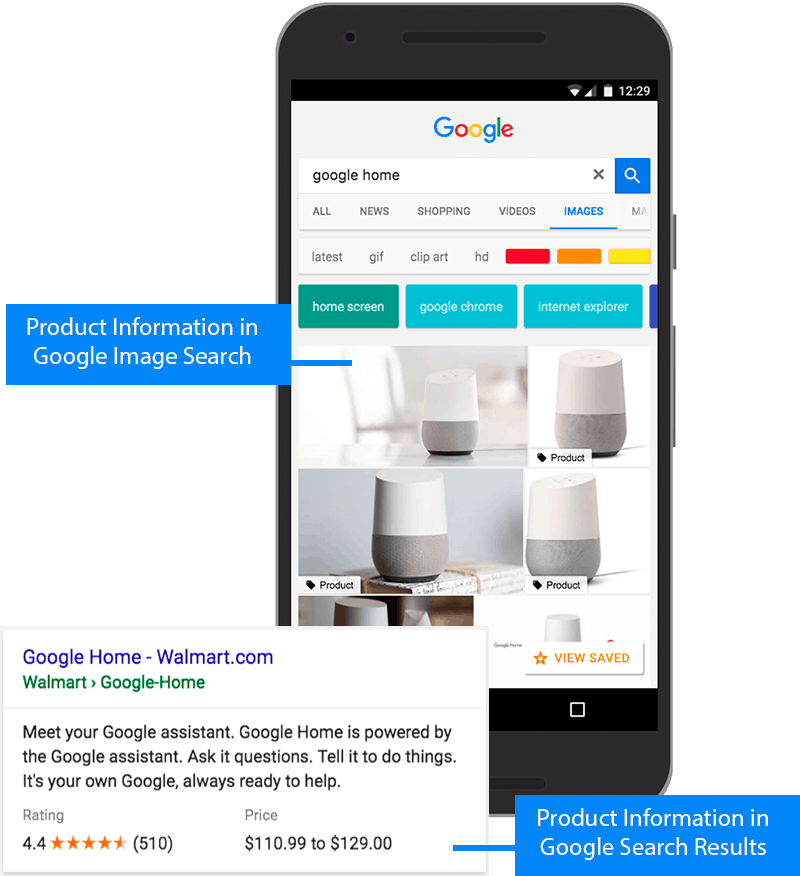
Again, users who care about this information are more likely to click your results if you provide the right details. Aside from increasing CTRs from Google Search, this traffic has already given the thumbs-up to your review score and pricing, which means they’re automatically more qualified by the time they land on your page.
This should mean higher conversion rates and it will also mean you’re less likely to spend money on remarketing campaigns for visitors who aren’t interested in buying.
These are all indirect benefits but this doesn’t make them any less valuable.
The only problem with structured data is that it can be time-consuming to implement and troubleshoot. There can be a number of technical issues along the way and you will eventually get recommendations from Google, which may require further optimisation. If you’re interested in enhancing your search results using structured data but think you need some help with the technical aspects, you can get in touch with our search marketing team for some guidance.