
Quality content is difficult to produce and there’s nothing more frustrating than seeing your content stolen by someone else. Search engines love unique content but recent comments from Google’s John Mueller suggest it may not be as important as many SEOs think.
So let’s take a look at what the Google Search Advocate had to say about unique content to determine how much it affects your search ranking.
What does unique content mean in SEO?
In SEO, unique content refers to web pages containing information that is original from other pages, even if they’re covering the same topic. Essentially, this is the opposite of duplicate content where pages use the exact same or similar wording as other pages for the same topics and keywords.
If we take a look at Google’s definition of duplicate content, anything that doesn’t qualify as the following could be considered as unique:
“Duplicate content generally refers to substantive blocks of content within or across domains that either completely match other content in the same language or are appreciably similar. Mostly, this is not deceptive in origin.”
While it’s tempting to define unique content in absolute terms, it’s actually a subjective quality and some content is more unique than others. Some content may be so unique there’s nothing else like it published on the web while most content can only be so unique, especially when you’re covering the same topics and targeting the same keywords as your competitors.
This raises the obvious question: how unique is unique enough in SEO?
How much does unique content affect search ranking?
John Mueller recently stepped up to help answer this question in a recent Google SEO office hours session when a publisher whose content was being copied asked about the importance of unique content.
Mueller started by explaining that, as far as he knows, there is no aspect of Google’s algorithms that specifically looks for unique content:
“So as far as I know, there is no aspect in our algorithms that says, oh this is something that is very unique to this one website and will, because there’s something very unique here we will rank it higher for all kinds of other queries.”
He went on to explain that, unless someone is searching for something very unique and you are the only publisher that provides it, content uniqueness isn’t really a factor:
“Obviously if you have something unique and someone is searching for that unique thing then like we will try to show your site there… But for kind of the generic case where someone is searching for something generic and you have unique things that also map into that generic category, I don’t think we would rank your pages higher just because they’re unique things.”
After discussing instances where content is stolen (we’ll talk about this in a moment), John Mueller clarified that “it’s not the case that we will rank your website higher just because like we’ve seen some unique things on your website.”
How much does duplicate content affect search rankings?
We recently covered this topic in a blog post looking at the impact of duplicate content and “fluff” on search rankings.
John Mueller has talked about this in the past several times, too, stating that Google doesn’t penalise duplicate content unless it strongly believes you’re intentionally trying to manipulate its search algorithm.
Instead, Google simply chooses one version of duplicate content to rank for any given query. So, if you have multiple pages on your website with duplicate content, it’s likely only one of them will rank for relevant queries. On the other hand, if your website includes duplicate content that’s also published on other websites, Google probably only going to rank one of these pages.
This means the risks of having duplicate content on your own website are minimal but you could prevent some pages from ranking if Google has to make the decision – one instance where unique content can be important (eg: product descriptions).
Potential issues from having duplicate content on your website that is also present on other sites (either because you’ve copied it or someone has copied your content) is more problematic – and we’ll talk about this in the next section.
The other scenario is that Google decides you’re creating manipulative duplicate content and the search giant has a clear policy on this:
“In the rare cases in which Google perceives that duplicate content may be shown with intent to manipulate our rankings and deceive our users, we’ll also make appropriate adjustments in the indexing and ranking of the sites involved. As a result, the ranking of the site may suffer, or the site might be removed entirely from the Google index, in which case it will no longer appear in search results.”
Much like the topic of unique content, the issue of duplicate content is overblown by a lot of SEO. Yes, it’s a factor you want to understand and know how to manage but, in most cases, the impact on your search ranking should be minimal or non-existent.
What can I do if someone steals or copies my content?
If you discover your content has been stolen by someone else, you can report the content to Google and request its removal from search. You can do this by visiting the Removing Content From Google – Legal Help page on Google’s support centre.
You’ll be asked to select the platform where the offending content is located and, for the purposes of reporting duplicate content, you’ll want to select Google search from the options.
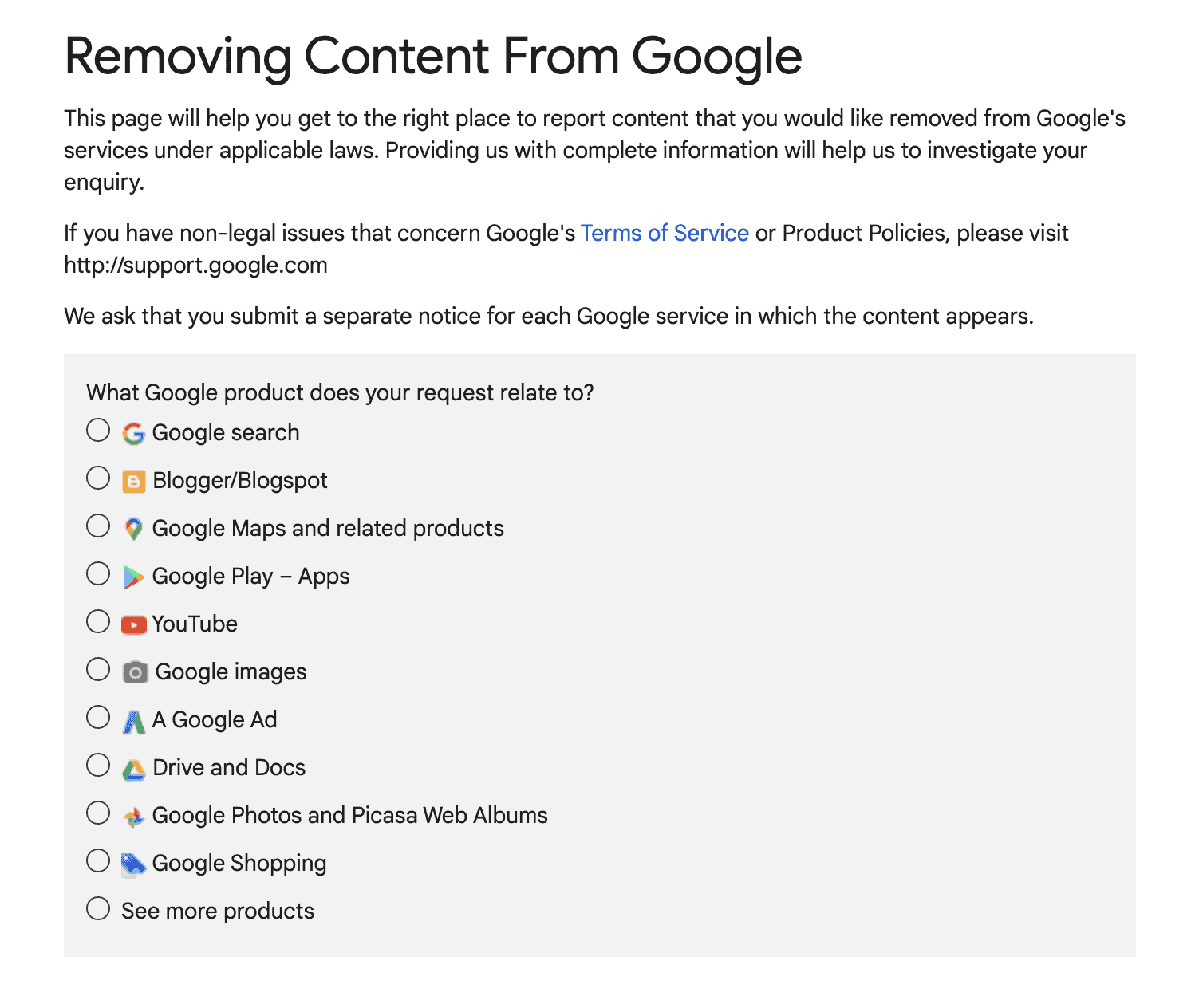
Next, you’ll be asked whether the content in question is showing in Google Search or Google Images and, then, the reason you’re requesting its removal. For stolen content, you’ll want to select Intellectual property issue from the list to report copyright infringement.
On the next step, select copyright infringement: my copyrighted work is being used illegally without authorisation and you’ll be asked to confirm that you’re the copyright holder of the content you’re reporting.
Next, you’ll be asked to complete a form with your details and a description of the work you wish to report, including URLs of the offending pages. This is a legal document and you’ll be asked to sign the request before submitting it for review.
If Google is unable to remove your stolen content from search, you can pursue legal action yourself through the EUCD (European Copyright Directive), which normally starts with informing the offender that they are illegally hosting copyrighted content. This is the closest equivalent to the US DMCA Takedown or Cease and Desist system but the process is slightly different – so get the necessary legal advice if you wish to pursue this option.
Is your content unique enough?
As John Mueller explains, Google doesn’t have a system for measuring unique content and it isn’t particularly concerned about how original your content is. It’s more interested in how relevant your content is to users’ search queries and the quality your content delivers.
A lot of SEOs fall into the trap of mistaking the idea of unique content for a key aspect of content quality but this simply isn’t the case.
The best content delivers what users are looking for most effectively and this should be your priority. In this sense, the best way to make your content unique from your competitors is to make it better by delivering higher quality and engaging users to show Google your page deserves recommendation over similar pages.
If you’re struggling to create content that ranks well in Google Search, our search marketing team can help you come up with a better strategy. Call us on 0161 870 2580 to speak to us today or fill out the form on our contact page and we’ll get back to you.