
Social advertising has endured a tricky few years, largely inspired by a backlash against fake news and questions raised over the targeting of political ads. These issues have forced users and even the networks themselves to reevaluate things and we started to see the first implication of this in 2019.
Now, we’re looking ahead to 2020 and what the state of social advertising is going to look like this year – and the next decade.
Facebook usage declining
Facebook’s colossal growth had to peak at some point and the world’s biggest network is now actually seeing usage decline – both in terms of user numbers and the amount of time spent in the app.
So what does this mean for social advertisers in 2020?
The boring (and realistic) answer is that, for now, advertisers simply need to keep an eye on performance metrics and keep in mind that usage numbers could be a variable to consider – probably not now, but at some point in the near-mid future.

Source: eMarketer
Something that could accelerate the impact of Facebook usage declines is the fact that users are now seeing fewer ads and less corporate content in their News Feeds. The network has been forced into a transition period where it needs to decide what role ads are going to play and we’ve seen a number of new ad solutions tested over the past couple of years.
Interestingly, the network has just decided to hold off on selling ads on WhatsApp.
If Facebook has been a crucial part of your social strategy in recent years, there’s no need to panic about the changes that are currently taking place. However, it is the time to keep a keen eye on developments and question where Facebook users will turn to next.
Instagram growth is also slowing
Data from eMarketer suggests that Instagram’s growth is also slowing. The network has enjoyed huge growth in recent years – far more than Facebook – but it seems the platform is starting to peak as it fails to attract users in the 35+ age bracket.
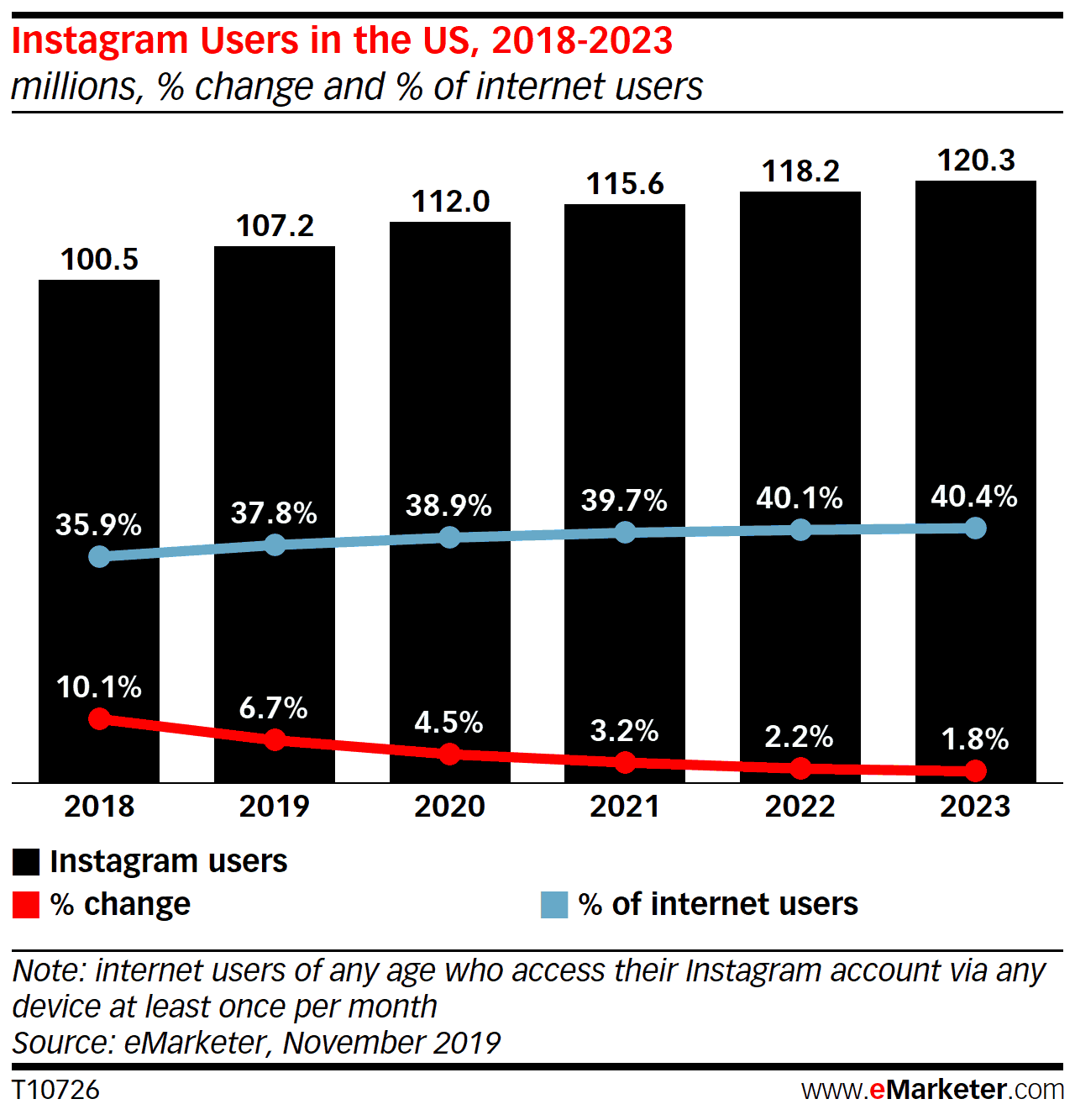
That may sound like worrying news but things are still looking very bright for Instagram, which has been over-performing for years – especially in the 25-34 age group. So advertisers looking to target this age group have absolutely nothing to worry about with Instagram.
If you can create visually compelling content, Instagram is the most important network to be on for this age group.
The key thing for Instagram will be whether it can continue to attract users of that age as its existing user base grows older. As far as a long-term strategy, this will be far more important than worrying about users in the 35+ demographic – something the network should be able to achieve as its userbase naturally reaches this age group.
What happened to Snapchat?
Well, unfortunately for Snapchat, Facebook happened. In 2013, Facebook reportedly tried to buy Snapchat for $3 billion but CEO Evan Spiegel sent Zuckerburg packing. So, Facebook turned to Instagram, which it bought in 2012 for $1 billion, and used the network to take Snapchat on directly.
Instagram promptly released its own stories feature, which was the key aspect of Snapchat that set it apart from other networks. And, since then, Instagram has relentlessly mimicked Snapchat features that could be a threat – everything from face filters to disappearing messages.
And, whatever you might think of Facebook/Instagram’s business conduct, it has worked.
A clumsy redesign from Snapchat in 2018 cost the network millions of users, including high-profile celebrity names during a time when influencer marketing was securing its place as a key aspect of the industry.
Now, when you think of influencers, you think of Instagram. When you think of social advertising, you probably don’t think of Snapchat.
Is TikTok going to upset the party?
Snapchat was supposed to be the next big thing in social advertising, a network that could rival the likes of Facebook by engaging with the youth of today and the future of tomorrow. In 2020, we now know that’s not how things panned out for Snapchat but there’s a new social network that’s gaining a serious amount of traction with younger audiences.

Chinese social media app, TikTok, is taking off in “Western” countries and this could be the first network to truly conquer global audiences. Social users in China, South Korea and Japan tend to prefer homegrown products, such as Weibo, Kakao and Line. The prospect of a single network that could dominate China, the US, Europe and other major regions will have Zuckerberg shaking in his sneakers.
Steady options for B2B advertisers
While there are signs of change on the social media landscape for B2C advertisers, things are pretty stead in the world of B2B social advertising. LinkedIn still retains its position as the undisputed B2B network and it’s difficult to see this changing any time soon. Microsoft bought LinkedIn in 2016 for a chunky $26.2 billion and fee and decided to basically leave the network alone, aside from integrating LinkedIn with other Microsoft products.
This was a good move.
Meanwhile, Twitter has steadied the ship after years of uncertainty and it now looks like a solid choice for both B2C and B2B advertisers. If anything, it’s looking like the perfect partner to LinkedIn for a fully-fledged B2B advertising strategy. Not quite the Twitter success story that was being hyped up in 2013 but a reliable choice for advertisers moving into 2020.
The only thing that has really changed for B2B social advertisers in recent years is the emergence of platforms like Quora and communities bringing back some of the old forum magic that used to dominate the web. These are a far cry from the hectic world of Instagram and TikTok but online communities are proving to be a steady option for B2B advertisers.
For social advertisers, 2020 is a year to keep one eye on new developments and the other on key performance metrics to see if any of the external chatter is actually making an impact on their own advertising strategies. It’s easy to look at declining Facebook usage and think the sky is falling in on social marketing but this is a network that still has almost 2.5 billion users.
Losing a few million users isn’t going to have a major impact on ad performance but we always knew the time would come where Facebook growth would stall and decline.
It appears that time may have arrived.
Likewise, a network like TikTok isn’t going to disrupt things overnight ( if it ever does) and let’s not get ahead of ourselves for another Snapchat fiasco. Above all, your target audience is always going to be somewhere, whether it’s Facebook, Instagram or another mix of networks. As long as you’re able to identify where these users are, gradual disruption shouldn’t cause any major problems to your advertising strategy.