
Earlier this month, Google announced the introduction of continuous scrolling in Google Search on mobile devices.
This means the page structure is disappearing from mobile search and, when users scroll past the first 10 organic results, the next batch of links will automatically load without users having to click through to any further pages.
We’ve seen Google test this on mobile in the past but the search giant is now rolling out the change for real, starting with English results in the US. In this article, we ask what this change will mean for search engine optimisation (SEO) and pay-per-click (PPC) advertising on Google Search.
Continuous scrolling comes to mobile
Google released a short post on 14 October to announce the introduction of continuous scrolling in mobile search. Product Manager at Google Search, Niru Anand, offered a brief explanation of the thought process behind the change and how it’s designed to enhance the search experience for users.
“At Google, we’re always exploring new ways to help people find what they’re looking for quickly and easily. Earlier this year, we launched a redesign of the Search results page on mobile for a more modern experience that’s easier to scan and navigate. Today, we’re making browsing search results more seamless and intuitive with the introduction of continuous scrolling on mobile devices.
Now, when you reach the bottom of a search results page on your phone, the next set of results will automatically load with relevant information.” – Niru Anand, Product Manager at Google Search
Anand goes on to explain that, while many users find what they’re looking for in the first few results of the page, some queries lend to a more explorational experience – something we heard a lot about in Google’s recent preview of the upcoming Google Search redesign, powered by the search giant’s new MUM technology.
With regards to continuous scrolling, Anand says that “most people who want additional information tend to browse up to four pages of search results,” which may come as a surprise to some search marketers.
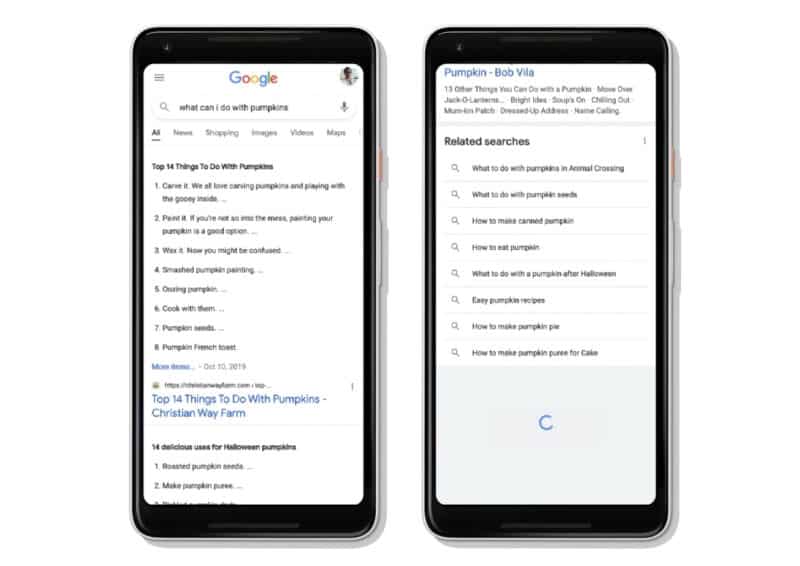
While page one is the most important placement for most search queries, users delve surprisingly deep in the SERPs when they want to find more information about a topic and, now, they can do this without clicking the “See more” button.
Anand offers the example of someone searching “What can I do with pumpkins?” for some Halloween inspiration. He describes this query as a “more open-ended question” and explains that users may want to consider more results and ideas than a single page provides.
“Scrolling through a wider range of results may show you tons of options you hadn’t considered, like no-carve pumpkin decor ideas for Halloween, pumpkin seed recipes that make your pumpkin worth carving and more ideas for how to make the most out of your gourd.”
With continuous scrolling, users no longer have the navigational barrier of having to click through to a second or third page – they can simply scroll past the first 10 organic results and keep going until they find what they’re looking for or decide to search for something else.
How does continuous scrolling affect SEO & PPC?
For search engine optimisation (SEO), the introduction of continuous scrolling will be an interesting opportunity for content that’s ranking in the bottom places of page one and the top positions of page two. By creating a single scrollable experience, content ranking at the top of page two could see more impressions on mobile and the impact on the lower results of page one could vary from one query to another.
Will the 10th search listing be perceived as more valuable by not sitting in the bottom position of page one or will it lose visibility as it’s surrounded by listings above and below the former page divide?
The more complex question, at this stage, is what does this mean for PPC ads in Google Search?
Well, Product Manager at Google Ads, Mohamed Farid, published some FAQs on this Google Ads Help page, which might clear up a few things:
Q: Is there any change to where my ads can show on the search results page?
Our systems recalculate Ad Rank for each search results page to ensure that the most relevant and helpful ads are shown at the top. As part of this change to how search results show, we’re redistributing the number of text ads that can show between the top and bottom of pages for US-English mobile queries. Now, text ads can show at the top of the second page and beyond, while fewer text ads will show at the bottom of each page. There is no change to how Shopping and Local ads show.
Q: Can my ads show more than once for the same query?
Yes. Ads have always been eligible (based on Ad Rank) to show on a search results page and again on a subsequent page. Our systems calculate your Ad Rank for each page and take into account whether your ad was shown on a previous page.
Q: What should I expect as a result of this change?
Search, Shopping, and Local campaigns that serve ads on US-English queries may see more mobile impressions, which could result in lower CTR. We expect clicks, conversions, average CPC, and average CPA to remain flat.
Additionally, Search campaigns may see more impressions from top ads and fewer impressions from bottom ads. To understand your performance based on where your text ads show on the search results page, consider segmenting your performance data by “Top vs. Other” and reviewing your prominence metrics. There is no change to these reports.
Based on this information, here are some key points to keep in mind:
- Ads can continue to show at the top of the second page (and other pages) – these will load in between organic results as users scroll
- Fewer text ads will show at the bottom of pages on mobile
- Shopping ads will continue to show as normal
- Ads can show more than once for the same query – but this has always been the case (depending on Ad Rank)
- You may see more impressions on mobile
- You may see higher impressions from top ads and fewer impressions from bottom ads
- Clicks, conversion, avg. CPC & avg. CPA expected to remain flat
Farid doesn’t recommend changing anything as continuous scrolling rolls out but suggests you might want to segment data by “Top vs. Other” to see how metrics vary across ad positions. For now, continuous scrolling is only rolling out in the US so there’s no immediate impact for campaigns running in the UK, but the rollout is due for expansion in 2022 and the UK tends to be among the first bunch of locations outside of the US.
Is your reporting & analytics ready for continuous scrolling?
If you’re concerned you don’t have the reporting and analytics systems in place to keep track of performance as continuous scrolling rolls out, our search marketing team can help you collect and manage the data you need to make informed marketing decisions. Call us on 0161 870 2580 or email us at info@hotclickmarketing.co.uk and we can help you set up reporting in Google Analytics, Google Ads and Search Console to get the full picture on your search marketing performance.