
Word count is a highly disputed topic in SEO – one that’s been studied, tested and analysed for years. The results have been inconclusive at best but the general consensus is that “longer” content tends to rank better in organic search.
Some studies suggest that the average word length for top 10 results is 1,500+ words, for example.
Unfortunately, this kind of study can only draw correlations without confirming that this content ranks higher because it has higher word counts. It’s like saying the top 10 richest people in the world all been to the Cayman Islands and suggesting is the reason they’re rich. Of course it isn’t. Just like the top 10 results in Google aren’t there simply because they’re longer than the others.
So what’s the real relationship between word count and SEO?
Does longer content rank better in Google?
On average, yes, longer content does historically rank higher on Google, but this doesn’t tell the full story.
A 2017 study by HubSpot calculated that the ideal word count for top-ranking content in Google is 2,100 words. To get this number, looked at the time spent on top-ranking pages for specific search queries and cross-references this with the average reading speed of users, plus a whole bunch of other factors.
It also linked to a separate study conducted by Capsicum Mediaworks that found the average word count for top-10 content in Google was between 2,000-2,500 words.
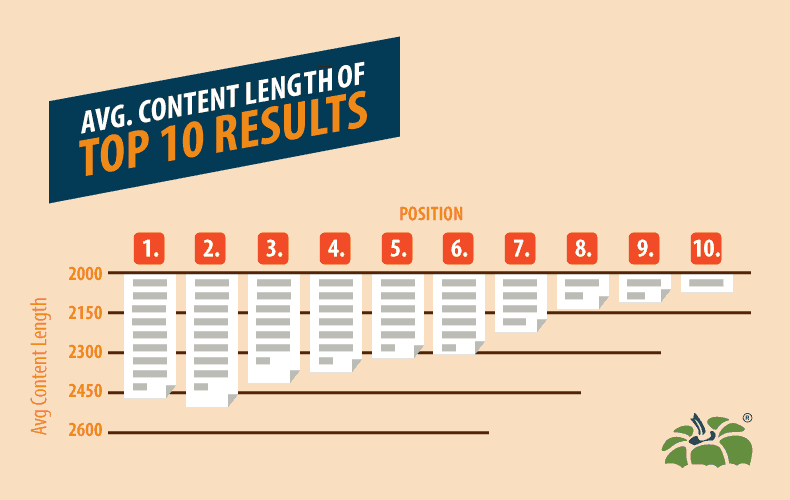
There are plenty of other studies from the likes of Backlinko and other names in the industry that come up with similar numbers, generally suggesting that high-ranking content tends to be between 1,500-3,000+ words. Some of these studies acknowledge that the findings are purely correlative, others do not.
What we do know from countless studies is that the best performing content does, in fact, tend to have longer word counts (1,500+). However, we also know this depends on the type of query users are typing into Google.

Click through to Weather.com from this featured snippet and you’ll see there’s basically no descriptive content in the main body at all. If you copy and paste every single word (header, body, footer, etc.), the word count is little more than 400 words, most of which is irrelevant to the search query – eg: “Lanzarote’s spooky underwater museum”.
Likewise, the top-ranking results for “nike sb shoes” is the official page Nike SB shoes on the company’s website. It features nothing but product listings so word count doesn’t into the equation. Again, if you want to copy and paste every word on the page, you could argue there are 705 words, a third of which are probably “Nike”.
Clearly, this is the most appropriate page to return for someone typing “nike sb shoes” into Google and some other brand writing a 3,000+ word landing page about Nike BS isn’t going to change that. So it all comes down the type of content users are looking for, the information they need and the action (if any) they plan to take.
Word count is not a ranking factor?
At this point, it makes sense to state the clear fact that word count is not a ranking factor. Key figures at Google have said this routinely and no amount of studies have been able to prove otherwise. More to the point, having word count as a ranking factor would be counterproductive – and we’ll look at this in more detail shortly.
First, let’s rewind back to August 2019 when Google’s John Mueller took to this Reddit thread to explain that: “Word count is not a ranking factor. Save yourself the trouble.”
More recently (last week, in fact), Mueller took to Twitter to once again ridicule the idea that word count is a way to beat rivals in the SERPs.
Having the same word-count as a top-ranking article isn't going to make your pages rank first, just like having a bunch of USB chargers isn't going to get you to the moon. But, I'm still tempted to buy some of those USB chargers…https://t.co/TIuJHwHufn
— johnmu (official) — #StaplerLife (@JohnMu) February 8, 2020
“Having the same word-count as a top-ranking article isn’t going to make your pages rank first.”
What’s wrong with word count as a ranking factor?
The problem with having word count as a ranking factor is that it provides no context whatsoever about the quality or relevance of a page’s content. It doesn’t make sense to reward one page that waffles on about a topic without offering anything of great value to a reader when another page delivers what users actually need in 500 words.
In fact, in this scenario, it makes sense for the second page to rank higher.
When someone wants to know what the weather’s going to be like in Manchester later on, do they need a meteorological explanation of the root causes behind the day’s rainfall? Probably not. More likely, they just want to know if it’s going to let off at any point and a featured snippet from Weather.com is all it takes.
Google’s priority is delivering the most relevant, useful content for each query and word count is no indication of content quality – it can’t be.
But what about content where longer word counts are beneficial to the user? Like an in-depth review about a product they’re interested in buying, for example.
When is longer content a good thing?
When users are looking for in-depth information about a topic, it’s clear they’re not going to get this from a 500-word blog post. Perhaps they want to read a review of the latest Samsung foldable phone or learn how to check for duplicate content on their website. Either way, they’re looking for detailed information that’s going to help them make a purchase decision or do something they were previously unable to.
The value in this type of content is providing the information this user needs to complete a task and this is why longer word counts are common among high-ranking informational content.
Does this mean word count is a signal for this type of query? Well, no, and it wouldn’t be a particularly reliable signal in this scenario, either. One of the most important principles of writing is to remove unnecessary words, shorten sentences and strive for concise content – the less is more theory.
So longer word counts can actually be a byproduct of lower-quality content.
However, one signal that we do know has a significant weighting in Google’s algorithm is the amount of time spent on the first page. Ideally, users are going to click through to a website, find the information they need and spend a certain amount of time engaging with that content, absorbing all of that useful info. Naturally, for a longer piece of content, it’s going to take more time for a user to read the page in full.
So, assuming you can keep users engaged throughout your content, longer word counts can boost other signals that do have a weighting in Google’s search algorithm. The challenge for Google is determining which queries should receive short, concise answers and which ones require more in-depth information.
Luckily, the search giant can compare sessions from billions of users to establish this.
Focus on relevance, not word length
From an SEO perspective, getting caught up on word length as a ranking factor is a waste of time. It’s not a ranking factor or a direct signal in Google’s algorithm. At most, Google may be looking at word count vs time on-page to get an idea of how much time a user should need to consume the content on any given page.
This doesn’t mean word count isn’t important, though. It’s a major factor for the end user who has to engage with your content but longer is by no means automatically better. As a general rule, you want your content to be as short as possible in order to get the required message/information across.
If you can do this in 800 words, it’s probably not a good idea to target 1,500 words.
You may also strategically choose to break a 5,000-word piece of content into five shorter pieces for internal linking purposes. Or you might publish a 1,000-word article and ask readers to download your 5,000-word eBook for more information. It all comes down to what you’re trying to achieve.
The ideal word length for any piece of content really comes down to what the user needs from you and how you’re going to deliver this. Focus your attention on creating relevant content that’s engaging to the end user and provides useful information in every paragraph, image, etc. And don’t be afraid to take words or entire paragraphs out during the editing stage if you find sections that don’t have anything useful to offer – your content is better off without them.