
One of the hardest things for business owners and new marketers to get their heads around is the role specific strategies like SEO and PPC play in their wider marketing efforts. This is understandable, considering how quickly trends develop in this industry and the constant emergence of new strategies.
So, in this article, we’re going to look at the following marketing strategies and explain what they have to offer in 2019:
- SEO
- Local SEO
- Pay-Per-Click advertising
- Social media marketing
- Content marketing
- Email marketing
- Conversion rate optimisation
By the time we’re done with this article, you’ll have a rounded understanding of what modern marketing involves and why and how these strategies are going to help you make bigger things happen.
Search engine optimisation (SEO)
Objective: Maximise website traffic and influence buying decisions with relevant content.
Search engine optimisation (SEO) is the process of optimising websites, pages and content to maximise your organic visibility on search engines like Google. Organic traffic comes from regular search results in SERPs (not ads) and SEO is a long-term strategy that aims to get your pages ranking as highly as possible for the search terms people type into Google.
The goal with SEO is to generate traffic from relevant audiences who demonstrate an interest in your brand – something that could lead to a future sale.
Normally, searches that demonstrate a high purchase intent (eg: “web design services,” “plumber near me” and “buy iPhone X UK”) trigger ads or local results, pushing organic listings down the SERPs. Now, it’s sometimes worth optimising for these in your SEO strategy to reinforce your paid ads and/or local results, but this is kind of a secondary role for SEO.
Most of your SEO efforts are going to be geared more towards lower-intent queries like “web design best practices,” “how to unblock a drain” and “best mobile phones in 2019”. These searches allow you to target users who aren’t sure whether or what they need to buy yet and start influencing their buying choices with strategic content: blogs, buyers guides, how-to guides, product reviews, email subscriptions, etc.
Local SEO
Objective: Get customers walking into your business via platforms like Google Maps.
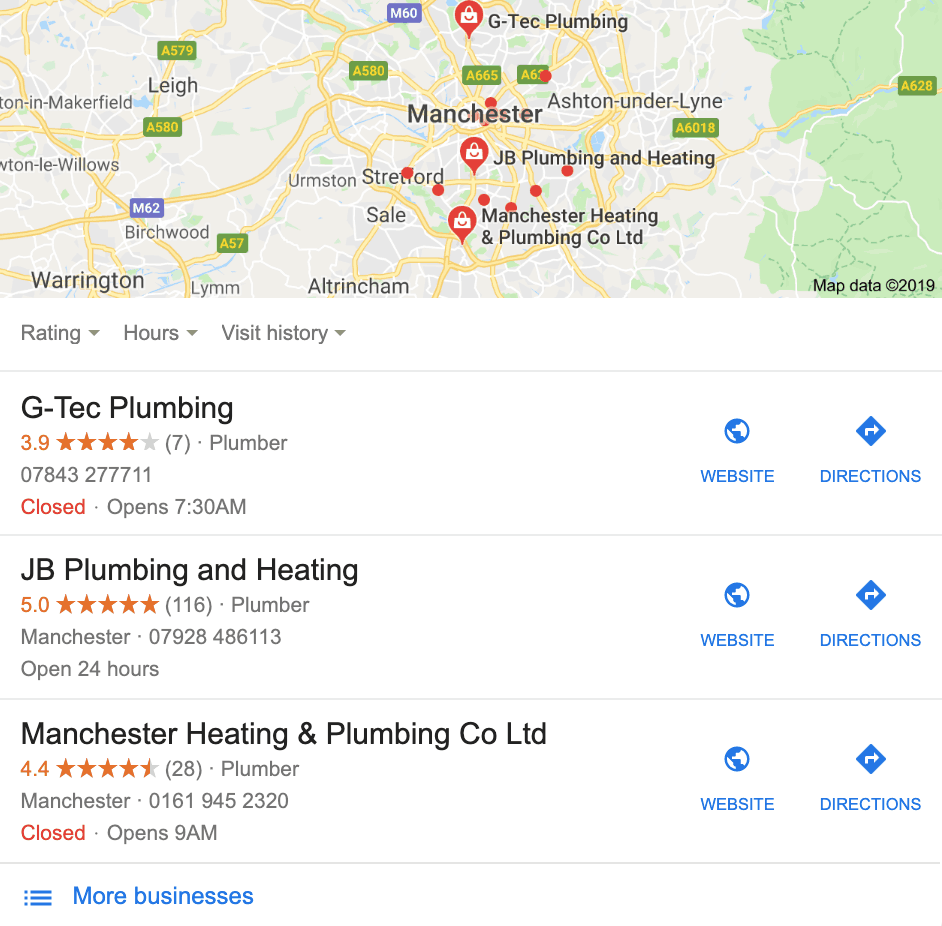
When Google detects searches with local intent, it delivers a local pack of results showing businesses in the users nearby area – or an area they specify. So, if someone in Manchester searches for plumbers, they’re going to see a local pack looking something like the one above. Likewise, if someone searches for “cafes in Madrid,” they’ll get a local pack showing cafes in Madrid’s city centre.
This is important for businesses with physical locations because local searches can generate foot traffic in your stores/locations, get them to pick up your phone or even visit your website. Users can also get directions to your business, see crucial info (such as open hours), save your business for future reference and interact in all kinds of different ways.
To find out more about how you can turn local searchers into customers, read our ultimate guide to Google My Business.
Pay-Per-Click (PPC) aka: paid search
Objective: Pay for high-intent traffic that’s ready to buy now or in the near future.
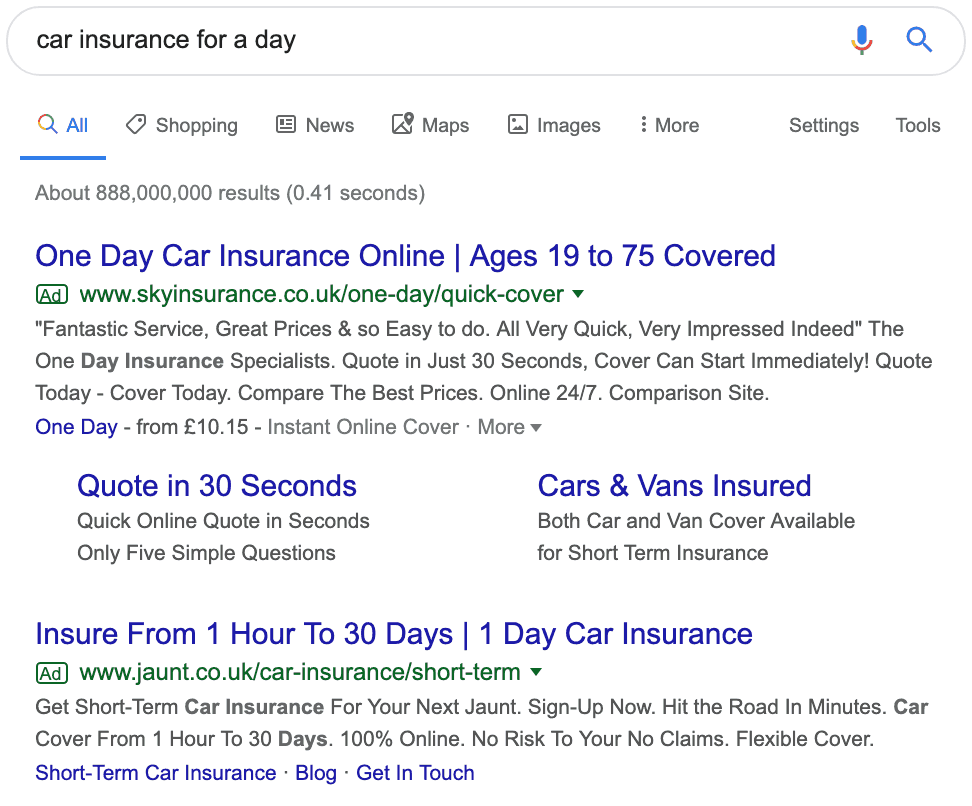
We mentioned earlier that high-intent searches (ones that strong intent to buy now or in the near future) typically trigger ads on search engines like Google (let’s not forget Bing, though). This is what makes paid advertising on the platform so effective: you’re paying for traffic that’s far more likely to buy from you than the traffic you generate from other strategies.
This is because you can target keywords that demonstrate urgency, such as “buy [product name],” “last minute flights to [location name]” or “emergency window replacement”.
Not all ad campaigns target such urgent search queries but PPC on platforms on Google is the only strategy that really allows you to pinpoint users who are itching to buy. A good PPC strategy will include campaigns for target audiences at all stages of the buying process and the keyword nature of paid search allows you to do this with great accuracy.
Combine PPC with SEO and you should end up with a comprehensive search marketing strategy that attracts leads at every stage of the consumer journey and guides them towards the finishing line.
Social media marketing
Objective: Engage with relevant audiences on social platforms and generate leads at earlier stages of the consumer journey.
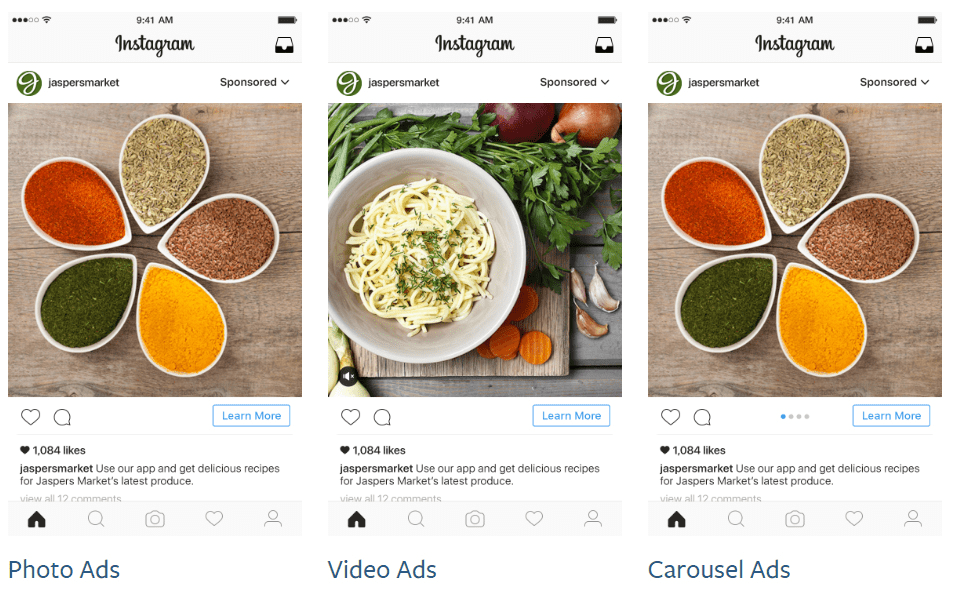
Much like search marketing (SEO and paid search), social media marketing involves both organic and paid social. Engaging with audiences organically on most networks is still relatively easy but generating genuine business leads on most networks requires paid advertising.
In fact, any good PPC strategy will also include paid social advertising.
The tricky part with paid social is knowing which networks you should advertise on, but we’ve got a handy guide that will help you make this decision. Once you’ve made that call, you’ll want to get familiar with the targeting options available on each platform because this is how you’re going to get your message delivered to the right users.
Luckily, we’ve also got some handy guide on this topic for you:
Content marketing
Objective: Generate relevant leads, email signups and influence buying decisions.
Today’s consumers engage with a serious amount of content before making buying decisions. With content marketing, your aim is to understand the needs of your target audiences at each stage of the consumer journey and deliver relevant content to, encouraging them further along the buying process, until they ultimately make the purchase from you.
In order to deliver your content to the right target audiences, you need to publish and promote it on the right channels: organic search, paid advertising, social media, email marketing, etc.
So content marketing overlaps with most of your other strategies and, in many cases, is the key resource powering those strategies – especially for SEO, social media and email marketing.
Email marketing
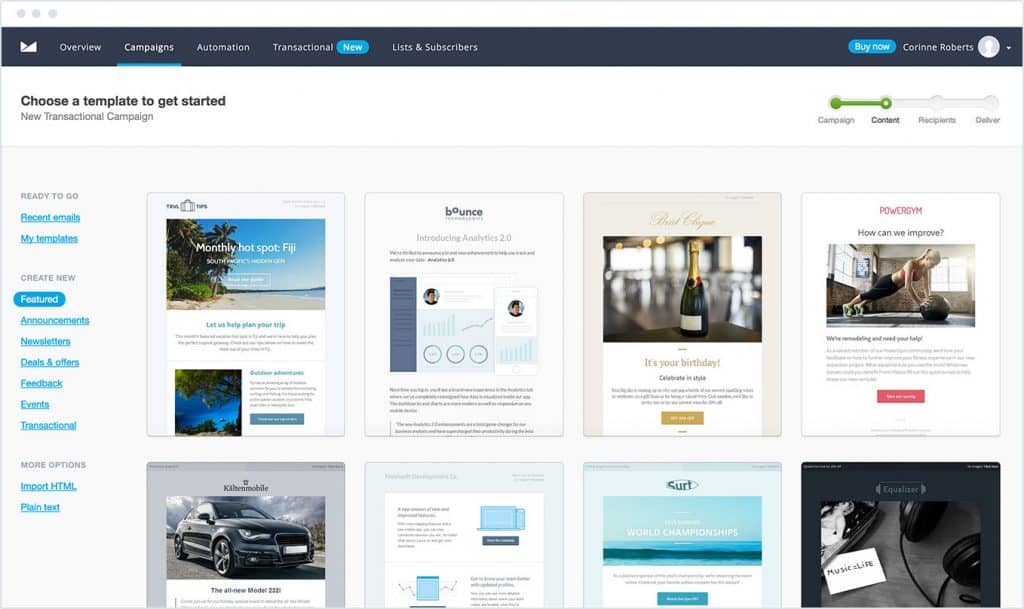
Source: Campaign Monitor
Objective: Nurture leads across the consumer journey and turn customers into repeat buyers.
Email marketing is the only channel you have to engage with users on a personal, individual basis. Assign data to people’s email addresses and you can do some powerful stuff in terms of guiding leads along the buying process and turning customers into repeat buyers.
To make the most of email marketing, you’ll want a sturdy customer relationship management (CRM) platform to help you assign information to each lead: names, actions taken on your website, position along the sales funnel, lead quality and all kinds of other datasets that allow you to create highly-relevant, personal and compelling messages.
You’ll also want a solid email marketing automation suite that allows you to continue targeting users with relevant messages as they progress further along the buying process.
Conversion rate optimisation (CRO)
Source: Hotjar
Objective: Turn more visitors into paying customers.
With your marketing strategies in full gear, you should be generating plenty of leads and turning a healthy percentage of them into paying customers. However, the average conversion rates generally sit between 2% and 4% with the very best brands topping out at around 20% conversion rates for their highest-performing landing pages.
In other words, there’s always room for improvement and conversion rate optimisation (CRO) aims to improve the performance of your most important pages to increase conversions.
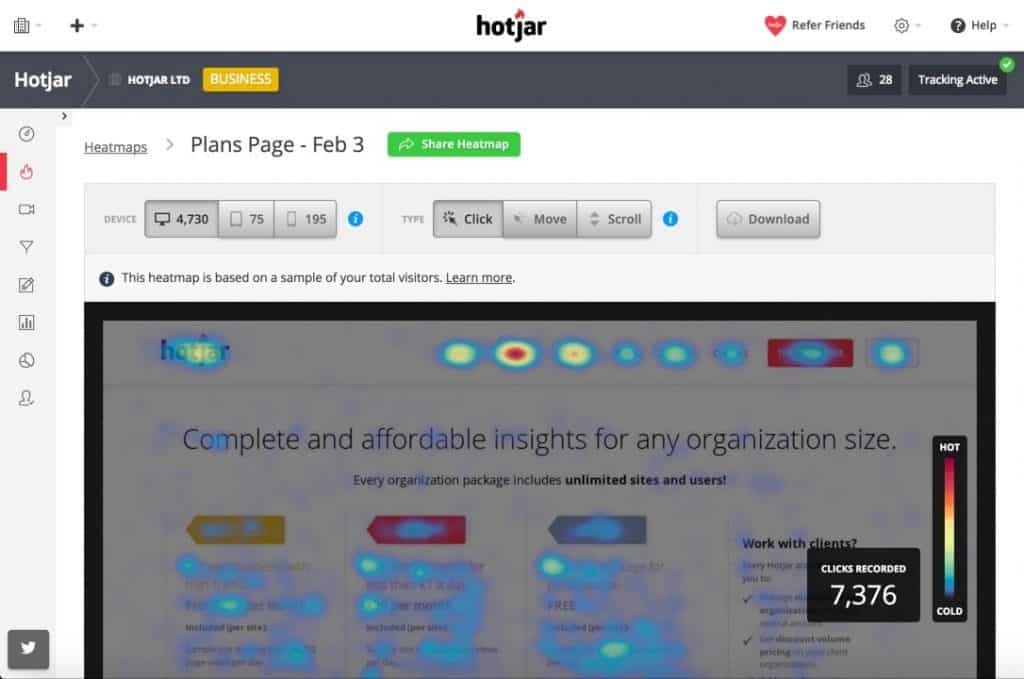
There are many approaches to this. For example, you might use heatmaps (pictured above) to look for issues users are running into on your pages. Then you have A/B testing – the most common method of CRO – which involves creating different variations of the same page (or elements of the same page) to see which version performs better.
The six marketing strategies we’ve looked at in this article are pretty much staples of modern marketing and most brands are going to need all of them to some extent – except perhaps for local SEO, if generating foot traffic has little/no value to you. The hard part is finding the right mix of these strategies and integrating them into a single marketing process that achieves your goals across every channel.
If you’re having trouble with this part in particular, be sure to reach out to us on social media with your questions or pick up the phone to speak to one of our advisors.