
Back in October, Google teased a new search experience expected to roll out at some point in 2022, using the new MUM technology that the search giant announced in June. We summarised the key features unveiled during Google’s Search On livestream in our own summary article, looking at how the latest AI breakthroughs are going to reshape the Google Search experience for users.
In today’s article, we look at what these proposed changes could impact the way users interact with search and what this means for SEO and content marketing.
A summary of the new features coming to Google Search
Before we get into what the new search experience could mean for SEO and content marketing, let’s remind ourselves of the key features Google’s teased earlier this year.
Visual search via Google Lens
The new Google Search experience will allow users to search visually using images and Google Lens on their mobile devices. The feature is designed for instances where users don’t know how to describe something, such as a pattern on an item of clothing that they like or a bike part they don’t know the name of.

Instead of struggling to find a name or description of what they’re looking at, users can simply take an image of the item and type in queries like “socks with this pattern” or “replace this part”. Google’s new AI powers combine image recognition technology with natural language processing to identify the subject in the image and understand the intent of the search query accompanying it.
Topic exploration in Google Search
On the more traditional side of search, Google has also previewed several upcoming features and design changes that move further away from search queries and deeper into topical exploration. Google wants to prevent the need for users to search multiple times to find what they’re looking for and encourage them to stay within the experience by exploring topics and refining their searches without having to use the keyword.

With the “Things to know” section, users can dive deeper into topics by clicking on one of the drop-down items that explore a specific avenue of the topic they’re searching for – eg: tips, step-by-step guides and styles.
When users are searching for broad topics, these help them steer the experience and filter content that’s more relevant to their interests without modifying their query.
Users can also use the “Refine this search” and “Broaden this search” sections to narrow the scope of their search and make it more specific or broaden it to include a wider scope of topical coverage.

Again, users don’t need to modify their search in any way; they can simply tap on any of the tabs that capture their interest and control the direction of the search experience.
Passage ranking
Google has already rolled out passing ranking, which allows the search giant to rank a page based on information provided within a snippet of the page content. Instead of simply relying on page titles, headings and other keyword-heavy elements, Google can now rank pages that provide the most relevant snippet of information, even if the page itself is targeting a broader or different keyword.
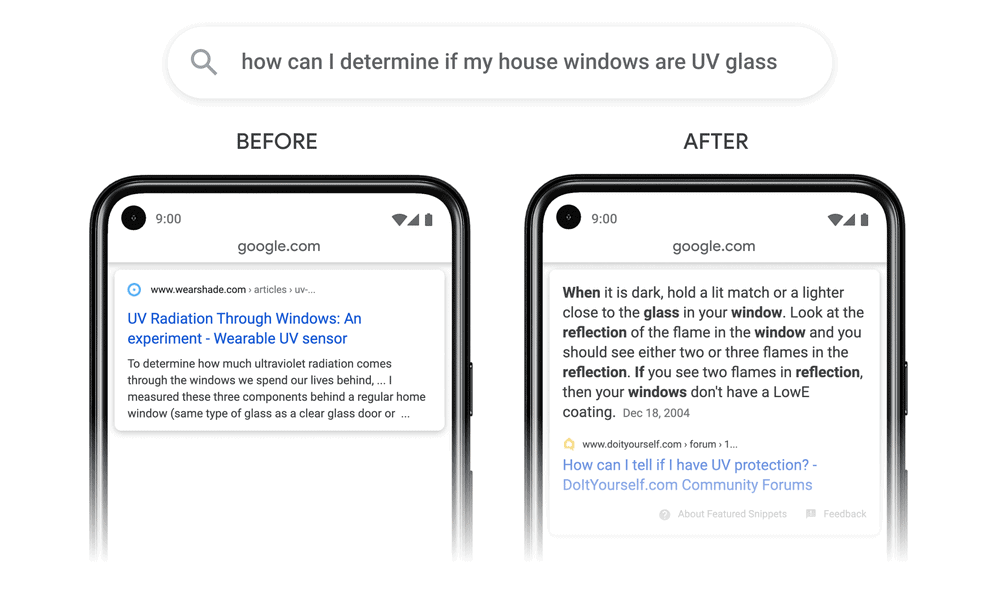
For example, the screenshot above shows a query asking how to check whether windows are UV protected. While the page showing on the left is optimised for the search query, the page showing on the right actually provides the more relevant information, despite the title not being particularly specific.
This means Google is now more capable of showing users the most relevant information at the top of results pages, even if it’s a snippet of text contained in a page that’s broader or less specific (as an entire piece of content) than other pages.
Related topics for video content
Google’s new AI technology has started showing related video content to users, based don’t the topic covered in the content they’re already viewing. The technology can understand the content in videos even where the topic isn’t specifically mentioned as a keyword in the dialogue by analysing the contextual information in the footage and matching it to other relevant videos.

Google explained a little bit about how this works on The Keyword blog when it announced the new feature.
“Using MUM, we can even show related topics that aren’t explicitly mentioned in the video, based on our advanced understanding of information in the video. In this example, while the video doesn’t say the words “macaroni penguin’s life story,” our systems understand that topics contained in the video relate to this topic, like how macaroni penguins find their family members and navigate predators. The first version of this feature will roll out in the coming weeks, and we’ll add more visual enhancements in the coming months.”
This brings the topical exploration concept to video content in Google Search and, along with the other enhancements Google has announced, gives us an idea of what the next age of search will look like – starting as soon as next year.
Why do these announcements matter?
The thing that stands out from Google’s recent announcements is that it’s clearly pushing towards maximising engagement during search sessions. Essentially, Google wants people to spend less time typing in queries and more time engaging with content and exploring topics.
So, instead of visiting a couple of web pages and quitting the session, Google wants users to continue exploring the topic of interest, delve deeper into information and explore related topics.
One take on this could be that Google is phasing out the importance of keywords, which is a common angle taken when Google changes anything in Search.
However, this misses the point of what Google is trying to do by redesigning the search experience.
Reducing the average number of searches users need to make
It’s not that Google taking anything away from keywords – in fact, it’s increasing its ability to better understand queries and return the most relevant results. What Google is trying to reduce is the number of queries the average user has to type in to find what they’re looking for and reduce the quantity of sessions where users fail to find what they’re looking for.
Google even mentioned this specific issue when it announced MUM to the world:
“Many of us tackle all sorts of tasks that require multiple steps with Google every day. In fact, we find that people issue eight queries on average for complex tasks… But with a new technology called Multitask Unified Model, or MUM, we’re getting closer to helping you with these types of complex needs.” – Pandu Nayak, Google Fellow and Vice President, Search; MUM: A new AI milestone for understanding information
The next sentence is the one that really matters: “So in the future, you’ll need fewer searches to get things done.”
When a user has to type multiple searches to find what they’re looking for, each instance is an opportunity for them to quit the session. Google says users perform an average of eight searches for complex tasks and this is clearly a problem for the search giant – one that MUM is designed to solve.
Increasing the time users spend in Google Search
By improving its understanding of queries and delivering more relevant content, Google can reduce the number of searches users need to complete to find what they’re looking for. This doesn’t seem to be all Google is looking to do with the latest search features and the redesign promised for next year.
If you look at the features we summarised above they all create a more engaging experience in Google Search. More importantly, most of them encourage users to explore topics further rather than quit the session once they’ve found what they’re looking for.
What’s particularly interesting with features like Things to know, Refine this search and Related topics is they specifically promote engagement in Google Search. Hopefully, users are visiting web pages to access information (although users can watch video content directly in Google Search) but the experience is encouraging them to return to search, explore the topic further and spend more time in the search experience without actually searching.
Google moving towards an exploration platform
If we’re reading these announcements correctly, Google is taking a series of steps away from traditional search and moving towards becoming an exploration platform. It seems clear that Google wants users to spend more time in search, exploring topics and engaging with content while spending less time manually typing in search queries.
This doesn’t come as a big surprise, considering the whole web has moved away from manual search into experiences dominated by discovery, exploration and engagement.
Social media may have driven this movement but users expect the content they love to find them, whether it’s on social media or streaming platforms like Netflix and Spotify.
Google has already responded to this shift with Discovery and Assistant but this is the first significant sign of Google reshaping the search experience across the board for both desktop and mobile. We can’t predict whether the new search experience will succeed in turning Google Search into an exploration platform but it seems like the logical progression and the implementation Google is proposing takes nothing away from the traditional search experience.
What does all this mean for SEO and content marketing?
If Google succeeds in adapting the search experience into one of exploration, this will have a major impact on the way users find and engage with content on the platform. Everything will still revolve around keywords, in the same way the People also ask section simply shows related queries. The difference is Google is making these suggestions and every recommendation is backed by vast amounts of data and AI analysis.
If users take to the new experience and spend more time exploring in Google Search, it will be important to learn how these recommendations impact the search/exploration experience. For example, will users spend more time exploring top-level keywords and less time refining their own searches with long-tail keywords?
This is simply one of many possibilities but an experience driven primarily by suggestions would require a different approach to keyword targeting and prioritisation for SEOs and content marketers.
Another big question is, what happens to keyword data if users explore topics rather than manually typing queries into Google Search? Every click on a suggestion is a keyword marketers can target but they need access to impressions, CTRs and other important data points for these suggestions.
Of course, all of this depends on how users take to the new search experience. If they don’t take to exploration in Google Search, the impact will be minimal but high adoption and engagement rates could have a major impact on referral traffic.
Marketers need to keep a keen eye on traffic levels for important keywords throughout 2022 and look out for any drops that could result from topic exploration – ie: users clicking on recommendations instead of typing in those queries. Top-level keywords would likely be the least affected in this scenario but you should definitely keep an eye on secondary and long-tail keywords, especially ones that generate high volumes of traffic, traffic that takes action (ie: high conversions) or traffic that your competitors are failing to reach.
Need help with SEO & content marketing in 2022?
If you need help with your SEO strategy or content marketing for 2022, you can speak to our search marketing team about an action plan for next year. Call us on 0161 870 2580 or fill out the form on our contact page to arrange a chat.