
Core Web Vitals will become part of Google’s core algorithm in May 2021. Although we already have lots of information (see our previous blog post on the subject), we’ll have to wait until rollout before we understand the full impact of these new ranking signals.
In the meantime, Google’s John Mueller has offered some fresh details in the latest Google Search Central SEO office-hours session on Twitter. So, here’s a quick summary of what we’ve learned.
New metric boundaries for Core Web Vitals
The first change to talk about is small but significant. Google has set new metric boundaries for Core Web Vitals, meaning the benchmarks you need to hit to receive any ranking benefit are slightly different now.
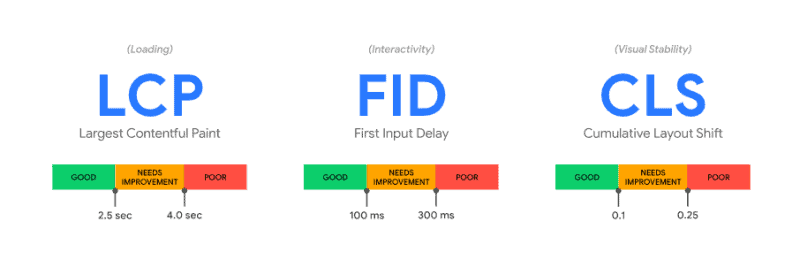
Previously, each signal’s boundaries were marked with the less than symbol (<), meaning you had to be under each threshold for any given rating. For example, loading times of less than 2.5 seconds counted as “good”.
However, Google has updated these boundaries with the less than or equal to qualifier (<=), which means loading times of 2.5 seconds or under now achieve the “good” rating.
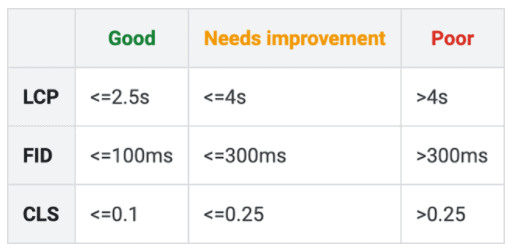
This means that LCPs of 2.5 seconds, FIDs of 100ms and CLSs of 0.25 now achieve “good” ratings where they previously would have received the “needs improvement” rating. While this change means little in practical terms, the updated boundaries make far more sense when you look at the visualisations Google is promoting, and the rounder numbers will also make these new signals easier to understand, remember and optimise for.
No ranking benefit unless your site meets all Core Web Vitals
Another piece of notable information from Mueller is that website owners will see no ranking benefit unless their sites meet all three Core Web Vitals thresholds.
“There are a number of factors that come together and I think the general idea is if we can recognise that a page matches all of these criteria then we would like to use that appropriately in search ranking.”
https://www.youtube.com/watch?v=wsrL6l2Fxvo
So, you’re not getting any ranking boost from the individual Core Web Vitals. You must hit the minimal requirements of all three to see any ranking benefit at all:
- Largest Contentful Paint (LCP): This measures loading times by tracking the time it takes for the largest element above the fold to render in full.
- First Input Delay (FID): This measures interactivity based on how long it takes for interactive elements to trigger after the user’s initial click.
- Cumulative Layout Shift (CLS): This measures visual stability by detecting any elements that move or change size after the page has loaded.
Make sure the largest element in the viewport of each page loads within 2.5 seconds; interactive elements respond within 100 milliseconds of users clicking/touching; and that elements don’t move around the page or resize after they load in the browser.
Core Web Vitals are the same for every type of website
A couple of days after the SEO office-hours session, John McAlpin put a question to John Mueller, asking whether the importance of Core Web Vitals metrics would vary for different types of site. For example, CLS being more important on eCommerce sites where clicking the wrong element could, theoretically, add unwanted items to shopping carts – or worse.
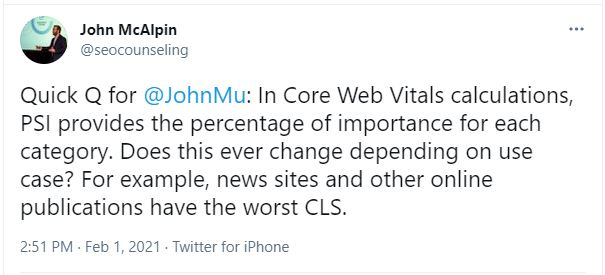
In his question, McAlpin highlights news sites where he suggests CLS can be especially bad. However, Mueller clearly stated that there’s no differentiation of website or page type.
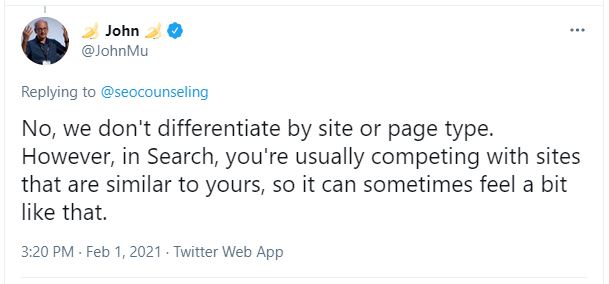
So, this isn’t like E-A-T and YMYL where certain websites, such as eCommerce websites, come under more scrutiny than others. The Core Web Vitals metrics apply to all websites and pages equally, and you either meet the minimum thresholds or you don’t. It’s more like passing Google’s mobile-friendly criteria, or having HTTPs encryption or not.
If you’re worried about the new page experience signal or Core Web Vitals, you can speak to our search marketing team for advice on how to optimise them ahead of rollout in May. You can call us on 0161 870 2580 or reach out to us on social media via @hot_click.